AI QUERY EXPERIENCE

JAN 2025

OVERVIEW
Sugarwork helps teams capture organizational knowledge through guided conversations, making expertise accessible across teams.
Previously, users had to select sources before asking a question, adding friction and reducing confidence in the AI’s answers.
We redesigned the experience around semantic search, eliminating manual source selection while making AI-generated answers more transparent and trustworthy.
ROLE
Product Designer
Owned problem framing, user research and UX/UI design
Team
1 PM, 1 Developer, 1 QA
Duration
4 months
Initial Iterations to Production
IMPACT
35%
increase in AI query adoption
50%
fewer steps to retrieve answers
Context and original flow
Sugarwork's AI answered questions using team conversations but users had to pick which ones to search first. Most users didn't know the right sources, so they often picked wrong, weakening answers and eroding trust.
Pain Point 1
Users struggled to find the right sources
Pain Point 2
Incorrect source selection led to weaker answers, reducing trust in the AI

INITIAL Direction
Initially, we focused on making source selection easier through improved search and filtering. Even with better search, users still had to understand the organization's knowledge structure before asking a question.


PRODUCT CONstraint
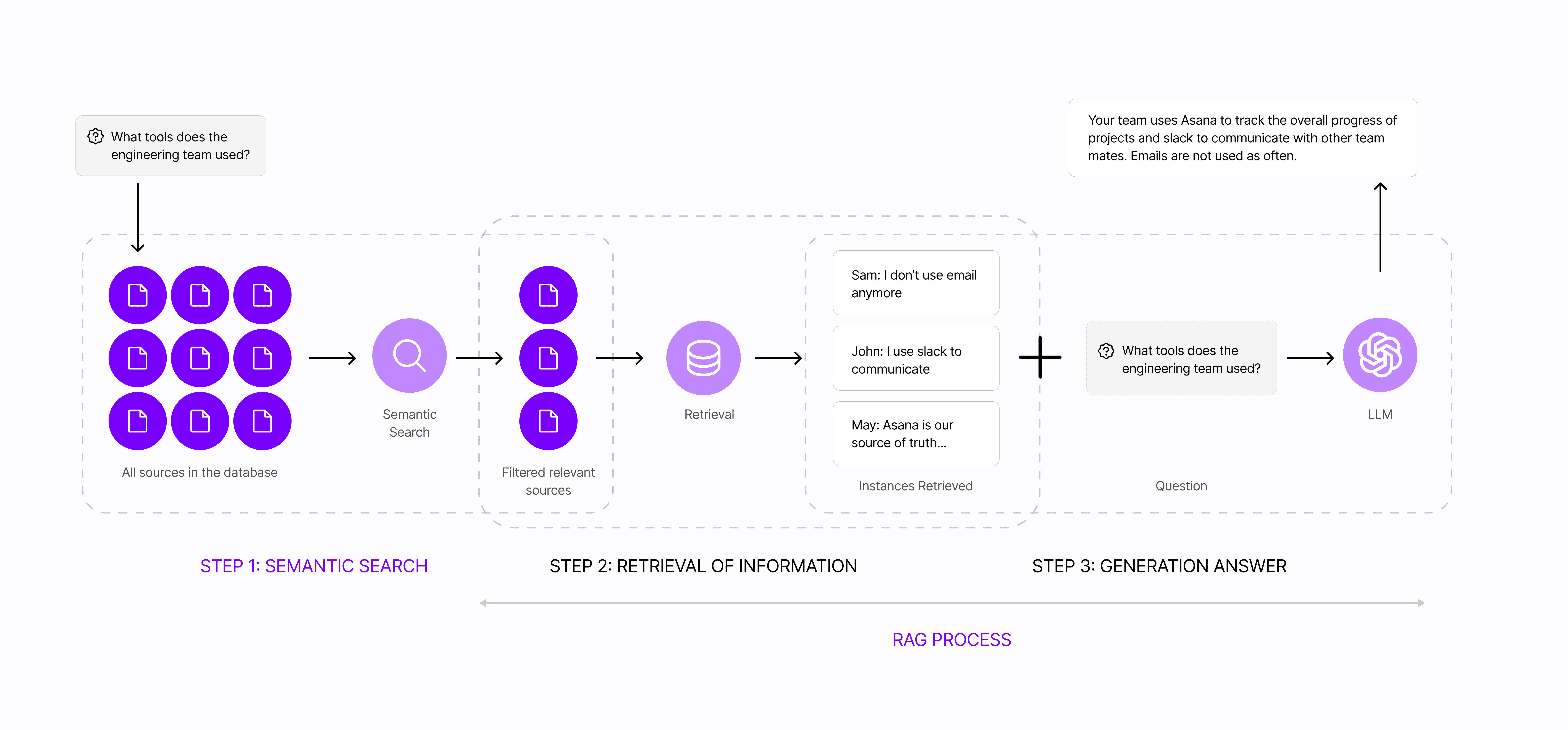
While we wanted users to search the entire knowledge base naturally, passing every document to the language model would reduce answer quality and increase latency. The challenge wasn't simply removing source selection, it was retrieving the smallest set of highly relevant knowledge before generating an answer.
Solution
Design decision 1
We enabled them to ask questions naturally while semantic retrieval identified the most relevant content in the background.
Design decision 2
To build trust, we explored exposing retrieved sources and confidence scores during loading. However, users found confidence scores difficult to interpret. We instead surfaced inline citations, a source panel, and timestamped video links, making it easy to verify where every answer came from.

Show sources while Loading with Strength
Source strength scores were difficult to interpret and showing sources before the answer created confusion
Selected

Inline citation and tagging to sources
Clear source citations let users navigate directly to the supporting context, making answers easier to verify.
Design decision 3
Helped users move beyond a single answer by introducing conversation history and contextual follow-up suggestions, making knowledge discovery feel like an ongoing conversation.


RESTROPECTIVE
Reframing the Problem
The biggest breakthrough wasn't a UI improvement, it was reframing the problem. We initially focused on making source selection easier, but speaking to users we realized, users didn't want to think about sources but get answers to their questions. Shifting retrieval into the background fundamentally changed how users interacted with AI.
Designing for Trust
Building trust required more than accurate answers. While we explored confidence scores to explain AI reasoning, users found them difficult to interpret. Clear citations, source context, and direct links to the original conversations proved to be a more intuitive way to help users verify answers.